

'I Was Born As A Girl'
These women return to their daily lives as wives and mothers, continuing to confront the ghosts of their girlhood and their pasts, holding onto hope as they await the day when justice will triumph.

The 50-day journey of two bipartisan representatives, Thomas Massie (R) and Ro Khanna (D), to secure the 218 signatures needed to bring the Epstein Profile Transparency Act to the House of Representatives was a “bloody eye” journey. They had to wait until House Speaker Mike Johnson swore in Representative Adelita Grijalva (Democrat, Arizona) to have 218 signatures. No representative “dared” to send a signature to the bill. Mike Johnson even responded to CNN, saying Trump was “an FBI agent planted to investigate Epstein.”
Until President Donald Trump spoke up, until Trump gave the green light for the Republicans to pass the bill, but still asserted that “the Epstein dossier is a scam by the Democratic Party.” A few days earlier, Trump had ordered Pam Bondi, the Attorney General, to investigate heavyweights like Bill Clinton and Larry Summers. A scam, but still investigating.
That “scam”, after being authorized by the president, the House Republicans dared to act with an overwhelming vote of 427 – 1; the Senate absolutely approved, and Trump signed it afterwards. The whole process, less than 36 hours. No hardship, no trouble, because the traffic signal was on.
Perhaps never before has the bipartisan vote been so unanimous, under Donald Trump. Congressman Thomas Massive called it a victory for the Democratic Party, for Epstein’s victims.
True or not? It’s too early to answer.
Congressman Robert Garcia of California bluntly answered the press yesterday, November 19: “We should not trust Donald Trump to do the right thing and release all the records about Epstein. The House Republicans continued to follow him. A few days earlier, they still had not signed, until Trump spoke up. But we are in the fight for justice, and we have only just begun.”
Pam Bondi told reporters at a press conference on Wednesday that the Justice Department would “comply with the law” to implement the transparency bill related to Epstein. 30 days were set for the records to be made public.
Now, there was nothing but waiting.
Once again, waves of controversy emerged from Washington, capturing the attention of both the press and the public. Trump insulted the media and embraced Saudi Prince Mohammed bin Salman, who had been shunned by the world for orchestrating the murder of a dissident journalist, declaring him “back into society.” Trump struggled to control himself when confronted with questions about Epstein. He even threatened violence against members of the Democratic Party, creating chaos on Capitol Hill and social media.
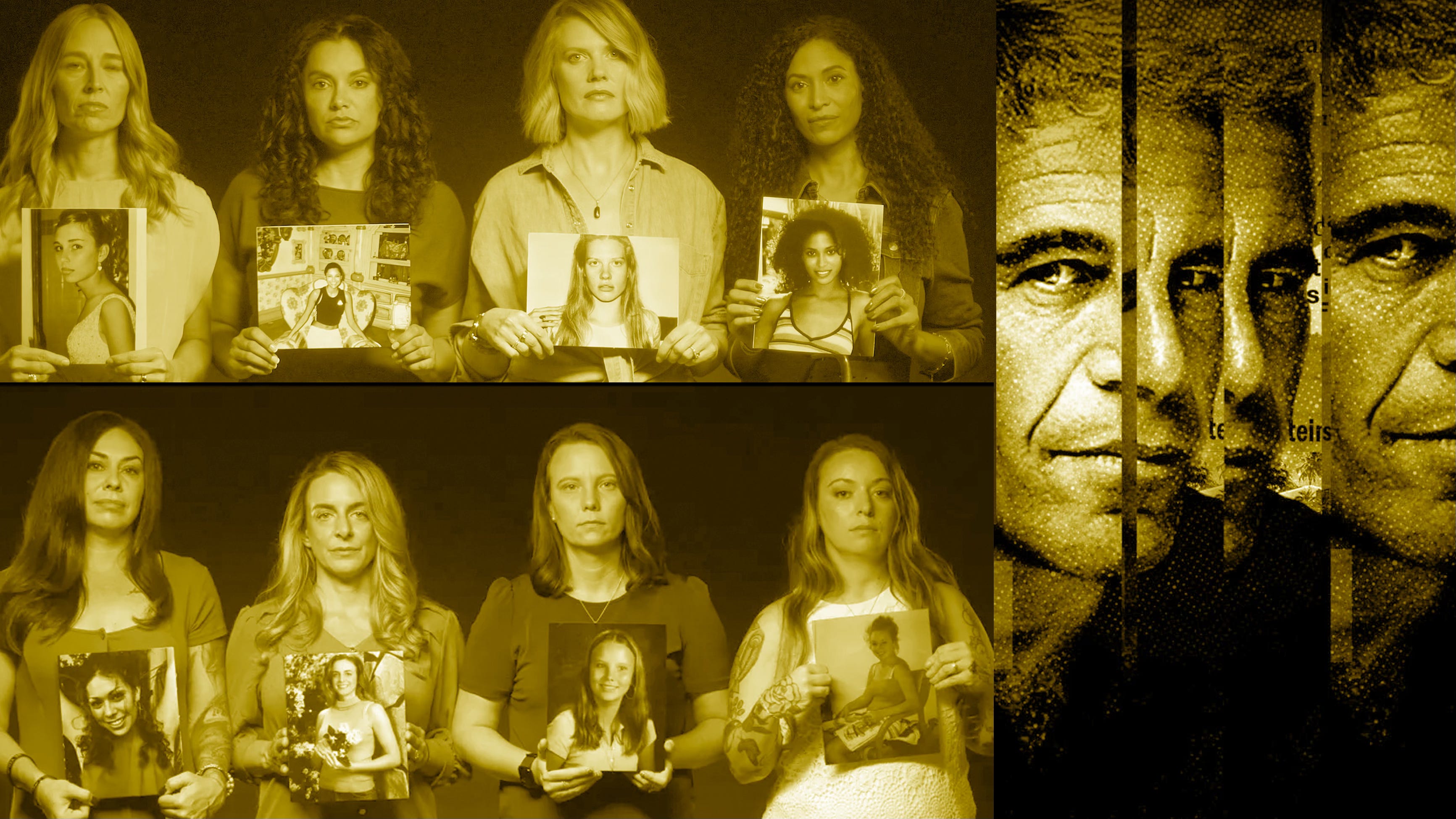
Meanwhile, the women who had previously held up their childhood photos in front of the Capitol’s House Triangle stepped back into the shadows, making way for another episode in this tense and bloody political drama. Their involvement should have concluded decades ago, but they have chosen to return to the Capitol stage, reigniting a tragedy from the past. Some have agreed to support MAGA Congresswoman Marjorie Taylor Greene, who plans to stand before Congress and read the names from the Epstein file aloud. What was once a tragedy has turned into a tragicomedy.
“I would be happy to stand beside to you, hold your hand, hold your coat in solidarity with you, if you decide to read the names on the floor,” said Haley Robson, one of the victims present at the press conference on November 18. “President Trump, I want to tell you, I am traumatized. I am not stupid.”

These women became victims of Epstein and Maxwell’s notorious sex trafficking ring when they were only 14, 15, 17 years old. Some were only 13. They were not afraid to show the world pictures of themselves at that age. Little girls with bright smiles. Like Virginia, who died, they were children without childhoods. Epstein and Maxwell were wizards in seducing teenage girls by using their dreams as a card. Then they bought silence with threats, with money, with the happiness of their families, as in the case of Danielle Bensky: “He threatened to prevent me from taking care of my mother, who had a brain tumor, and used the times my mother had to have brain scans to abuse me, forcing me to not disobey.”
The women who once endured the hell of the pink house at 358 El Brillo Way, Palm Beach, Florida, agreed, for the first time on September 3, 2025, to come forward and testify publicly before the people. They stood outside the Capitol, not in any state court. Even though it has been decades, the girls who were once women still tremble when talking about the past. After the press conference, the media surrounded the congressmen. Some of them quickly walked into the Congress, flanked by bodyguards.
The victims sat together in a corner of the Triangle. They were ready to talk to the people holding signs demanding transparency in the Epstein case.
I didn’t go to the second bipartisan press conference on Epstein held on Capitol Hill earlier this week. Maybe because I had a sense of what it would be like. What would the politicians say? Who would be there among Epstein’s thousands of surviving victims? What would they be like? It would be the same as the first press conference. Except the proponents of the Epstein Transparency Act would be more confident. MAGA Rep. Marjorie Taylor Greene would be more forceful in her criticism of the president.
The second press conference was live on several media channels. The same women. They still couldn’t contain their emotions when they spoke. Annie Farmer, a victim, pointed out that “this fight for transparency has been going on for many presidents. This is not a matter of a few corrupt Democrats or a few corrupt Republicans. This is a betrayal of the system. Because these crimes were not properly investigated, more girls and women have been harmed.”
When the second press conference ends, perhaps they will also sit together, supporting each other. Politicians rush into another fight, speculating who wins, who loses, and how many seats they will take. These women return to their daily lives as wives and mothers, continuing to confront the ghosts of their girlhood and their pasts, holding onto hope as they await the day when justice will triumph.
Khanh Ly’s mournful voice resounds [Bài Nhã Ca Thứ Nhất] (*)
I was born as a girl,
feeling as sad as a leaf drifting in the breeze,
a bit of a naive soul navigating these complex emotions.
The pale days have come and gone,
leaving behind a longing for their return.
I yearn for the warmth of this spring.
(*) [Bài Nhã Ca Thứ Nhất], poem by Nha Ca, music by Tram Tu Thieng